Discovery of the Buried Steel Chamber
The Legend of William OhDiscovery of the Buried Steel Chamber occurs during William Oh’s retreat through the Kaith cavern system, when survival, exploration, and historical discovery become inseparable. Injured and moving through a forest of man-eating mouths, William Oh finds an apparently impossible steel structure buried beneath the cave rock. Inside it are a red-lit egg, remnants of metal construction, a skeleton, and a preserved relic that he claims and equips. The chamber does not merely offer useful equipment; it reveals that the seemingly natural caverns conceal the remains of an older, technically sophisticated world.
Causes and Immediate Circumstances
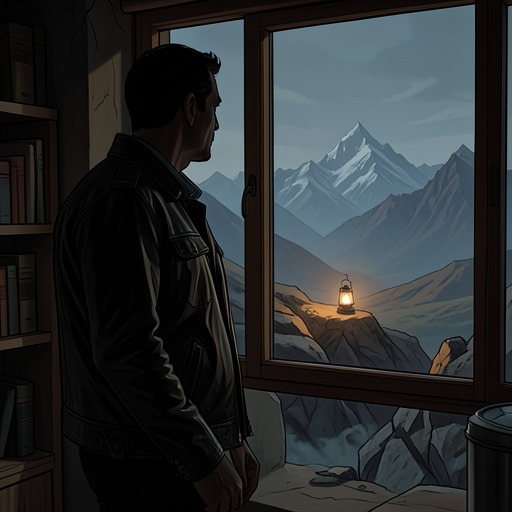
The discovery begins as a survival problem rather than an archaeological search. William Oh has already recognized that he cannot safely climb the wall while exhausted and injured: if one of the creatures catches his remaining arm, he will be unable to escape. He therefore gathers Loth’s glow-worms and creeps through the cavern, looking for an overhang or alcove where he can recover fully before attempting the ascent. The immediate pressure is supplied by the mouths descending from the cave walls, which consume Kaith corpses and search for further prey. His route toward shelter is consequently shaped by concealment, exhaustion, and the need to keep moving without attracting the creatures.
William Oh reaches an alcove only narrowly, limping through a space where the feasting mouths are close enough to seize him. He is prepared to switch to his tomahawk if necessary, but the alcove initially appears empty. That apparent emptiness is the first deceptive surface of the chamber. Something catches his foot, and when he passes a glow-worm over the obstruction, he finds a perfectly straight lip embedded in the floor. A tap of his tomahawk produces a quiet metallic chime, forcing him to revise his understanding of the cavern floor: it is steel, not stone.
The Buried Structure and Its Contents
The steel is only partly visible. White paint forms lettering across the floor, but the message vanishes beneath the seamless stone that makes up the surrounding cave system. William Oh cannot read the complete inscription, nor can he explain how painted steel came to lie beneath rock that appears solid and continuous. The question is therefore not simply what the structure contains, but how it came to be entombed inside the cavern at all. The discovery interrupts the ordinary distinction between natural dungeon and constructed ruin: stone seems to have grown over a manufactured interior, preserving fragments of an earlier installation while concealing its purpose.
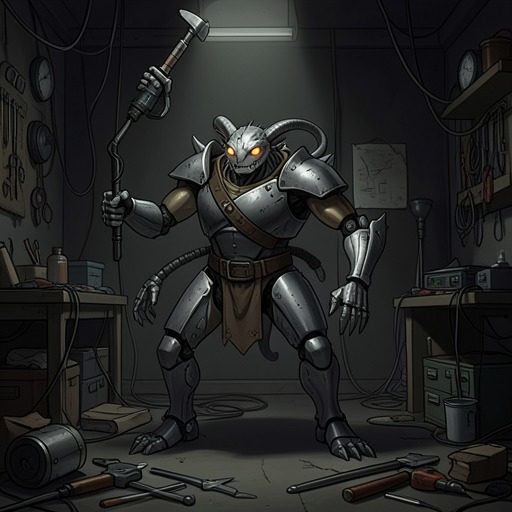
The alcove extends into a tunnel, and a faint red light eventually overwhelms the glow-worms in William Oh’s hand. At the end is a small room containing a single strange egg radiating red light. It has been placed high near the ceiling and secured by two metal wires looped around it. The room’s walls are partly steel and partly stone, with the stone appearing to have coated the metal like a creeping growth over centuries. The red-lit object is not explained, identified, or removed; its presence remains one of the chamber’s central mysteries, linking the buried structure to the living or quasi-living dangers of the cavern without resolving the connection.
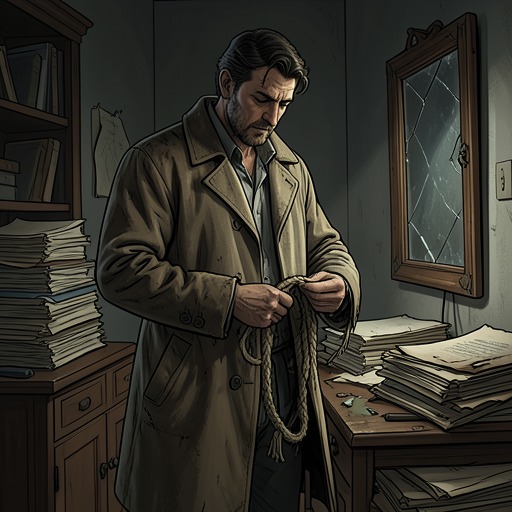
A skeleton occupies one corner. It is roughly William Oh’s size and still wears deteriorated roughspun clothing, a wool cloak, and leather boots. The body has been violently reduced below the waist, with everything beneath that point apparently gnawed off and carried away by a wild animal. The corpse therefore confirms that the chamber was not a safe refuge for its previous occupant. At the same time, the preserved equipment distinguishes the skeleton from ordinary decay: its left wrist bears a flawless archery armguard, while a sling and a crumbling pouch of apparently glass marbles lie nearby. The empty other hand offers no second ring, making the remains both a warning and a limited cache of salvage.
The Armguard of Tracers
William Oh understands that perfectly preserved equipment found on a corpse is likely to be a Relic, because Relics do not deteriorate in the ordinary way. Such objects can survive corrosion, landslides, and decades of water damage even when everything around them has decayed. Rather than treating the skeleton only as a source of loot, he acknowledges the continuity between the dead explorer’s abandoned gear and his own struggle by murmuring that he will carry it forward. He gently slides the armguard from the skeleton’s wrist and places it over his own handless wrist.
The equipment interface immediately identifies the object as the Armguard of Tracers. Its ability activates whenever the bearer makes a ranged attack: a trail of fire remains suspended behind the projectile for ten seconds, and the tracers burn anything they touch for moderate fire damage. For William Oh, who has lost a hand and depends on careful adaptation of equipment, the armguard is especially significant as a ranged modification in the gauntlet slot. It is not a miraculous restoration of what he has lost. Instead, it converts a preserved fragment of someone else’s failed expedition into a new tactical possibility, allowing him to carry the dead explorer’s equipment into the dangers beyond the chamber.
Consequences and Wider Meaning
The chamber changes William Oh’s understanding of the Kaith cavern system. Before the discovery, the tunnels are primarily enemy territory: a route for moving supplies to the front lines, a place of traps, chitinous threats, and mouths that can kill an exhausted Climber. Afterward, the same tunnels also become a buried historical layer in which steel construction, painted markings, wired machinery, luminous objects, and Relics have been swallowed by stone. The cavern is no longer merely a hostile natural environment or a battlefield logistical route. It is a material archive whose surviving fragments imply that the current world has been built over technological remains it does not fully understand.
The event also gives the broader climbing system a concrete physical depth. Climbers can reach the 2nd Floor either by established routes or by clearing a Key Site and opening an inter-floor Door, but the buried chamber suggests that ascent is not only a progression through levels and rewards. The Tower contains infrastructures, ruins, and devices whose origins precede the characters’ knowledge. Other locations reinforce this pattern: the grey ceiling of The Tower is fitted with reflective surfaces installed by Climbers thousands of years ago, and distant Strongholds still operate industrial mechanisms such as pumps, ballistae, and salt mines. The chamber belongs to that same tension between magic, relic technology, and forgotten engineering, but it presents the tension in its most intimate form: a wounded survivor discovers it beneath his feet while trying not to be eaten.
The discovery’s value is therefore both practical and epistemic. William Oh obtains the Armguard of Tracers, a weapon-enhancing Relic that can help him survive future ranged encounters, yet the more consequential acquisition is knowledge that cannot be reduced to an equipment description. The steel floor, incomplete white lettering, red-lit egg, metal wires, coated walls, and mutilated skeleton remain only partially legible. The chamber gives William Oh evidence without a complete explanation, turning survival into an encounter with a history that must be carried forward along with the relic itself.